
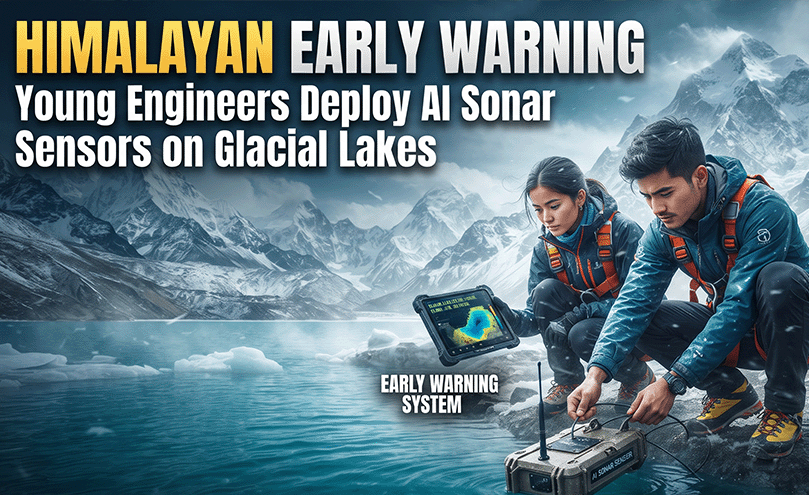
Himalayan Early Warning: Young Engineers Deploy AI Sonar Sensors on Glacial Lakes
Developed by Kathmandu robotics graduates, automated satellite telemetry stations protect 40,000 downstream villagers from catastrophic mountain flash floods.
High in the Everest and Rolwaling valleys, where massive glaciers are rapidly retreating under the warming sun, vast lakes of meltwater sit dammed behind fragile walls of loose rock, ice, and moraine. A sudden avalanche or seismic tremor can breach these natural dams in minutes, unleashing a catastrophic wall of water known as a Glacial Lake Outburst Flood (GLOF).
Now, young innovators from Kathmandu’s Institute of Engineering (Pulchowk Campus) have stepped forward with an indigenous technological shield. Operating in thin air above 4,800 meters, the engineering cohort has successfully deployed 14 solar-powered, AI-enabled telemetry stations directly on the water’s edge.
Rugged Innovation in Sub-Zero Cold
Imported environmental sensor systems frequently fail in the brutal Himalayan winter, where temperatures plummet below minus 30 degrees Celsius and heavy snowfall obscures solar collectors. The Nepali team engineered custom lithium-titanate battery enclosures and ultra-low-power sonar sensors that continue to ping water levels even when encrusted in ice.
Machine-learning firmware running on the microcontrollers filters out benign wave ripples while detecting sudden structural surges or rapid moraine slumps. Within 30 seconds of an anomaly, the unit beams an emergency encrypted burst via low-orbit satellite to the Department of Hydrology and Meteorology and automatically triggers siren poles installed in 28 downstream settlements.
“Climate change is not a theoretical model for us; it is our valleys and our relatives below the mountains,” explained the project’s lead software engineer. By building affordable, modular technology at home, Nepal’s young creators are proving that mountain nations can lead their own climate defense.


